ABOUT THE PROJECT & TEAM
The Institute of Museum and Library Services awarded the Wisconsin State Library Agency and Washington State Library a nearly $250,000 grant for a three-year project, titled “Empowering & Innovating Games-based Library Services: National Best Practices for Gaming Collections & Programming.”
In addition to recent data highlighting the staggering popularity of various games-based media (i.e., board games, video games, card games, virtual reality) with people of all backgrounds and ages, library research suggests something similar; according to the 2023 American Library Association report by Kathi Inman Berens and Rachel Noorda,“Gen Z and Millenials: How They Use Public Libraries and Identify Through Media Use,” the authors note that 53% of young library users identity as gamers – indicating immense potential that could influence library services for years to come. Games of all formats offer libraries a rich opportunity to enhance circulation and programming numbers while welcoming entirely new users into their spaces. There is no better time than now to improve games-based library services nationwide.
“We aim to demonstrate that embracing gaming in libraries means embracing innovation in libraries,” said Chris Baker, DPI Public Library and Games & Learning Consultant – and one of the leaders of the project. “Libraries that seek to remain not only relevant but forward-thinking and responsive to their communities’ needs must prioritize games-based collections and programs looking to the future. This project provides immense opportunity.”
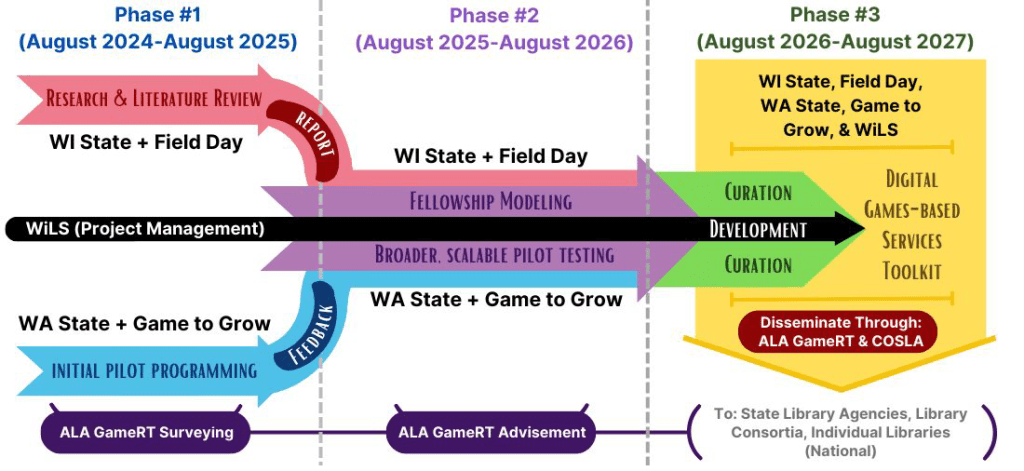
The project is designed with three phases in mind, generally aligning with the three years of the project schedule:
- Phase 1: The Library Services Team will partner closely with David Gagnon, Director and Scientist of Field Day (a Learning Games studio and research lab housed within the Wisconsin Center for Education Research of UW-Madison) to conduct rigorous nationwide research and a literature review of past and current games-based library services, ultimately to develop a comprehensive and foundational research report. Nationwide libraries (including Wisconsin) will be asked to participate in valuable surveys emailed out during this phase. At the same time, Washington State Library will collaborate with the non-profit organization Game to Grow and local games developer Heart of the Deernicorn to initially pilot games-based programs and collections throughout Washington libraries (with a particular focus on justice-facing youth facilities), acquiring rich feedback from users and librarians along the way.
- Phase 2: The research and feedback from the first phase will converge to support a more practitioner-focused strategy, bringing additional librarians statewide and nationwide into the fold to begin developing replicable and scalable games-based library service models. This phase will be facilitated with intentional input from targeted populations of library staff and library users via an open call for participation during the second year of the project– with the key goal of developing games-based library best practices, direction, and guidance, all through a lens of access and equity.
- Phase 3: The information generated in the first two phases will be utilized to develop a deeply-informed and comprehensive ‘Games-based Library Services Toolkit’ – an easily accessible, digital resource guide, which will be accessible for free to all libraries nationwide for years to come.
Project management of the three-year process will be spearheaded by the non-profit WiLS, supplemented by the participation, communication support, and promotional leverage of both the American Library Association’s popular Games & Gaming Round Table and the Chief Officers of State Library Agencies.
Project Updates
- Get in the Game! DPI Awarded Grant for Games-Based Library Services (Wisconsin Dept. of Public Instruction, October 2024)
Project Partners




Project Team

Chris Baker
Chris is a video games scholar and a Public Library / Games & Learning Consultant with the Bureau of Libraries of the Wisconsin Department of Public Instruction. Prior to his work with libraries, Chris enjoyed a robust career in professional theatre, earning his BA in Theatre from UW-Parkside and an MFA in Theatre Pedagogy from Virginia Commonwealth University, where he wrote his thesis about video games, learning, and society. Chris also has his MLIS from the University of Wisconsin-Milwaukee; he is a specialist in games-based library services (programs and collections), library project management, library innovation, and collaboration building. Chris is the 2026-2027 President of the American Library Association’s Games & Gaming Round Table. He is also obsessed with Czech medieval history and would love to chat with you about it! Pravda vítězí!

Jeff Brunner
Jeff is the Cooperative Purchasing Program Manager at WiLS. In his role at WiLS, Jeff helps members obtain the resources they need at prices that they can afford. He believes that libraries and other cultural institutions are strong forces for increasing social justice. He is a lifelong player of both digital and analog games.
Funding Acknowledgment
This project was made possible in part by the Institute of Museum and Library Services, National Leadership Grant LG-256639-OLS-24.
The views, findings, conclusions, or recommendations expressed on this website do not necessarily represent those of the Institute of Museum and Library Services.

